

Planning a food oil production line requires more than selecting a single oil press. The complete project should connect raw material preparation, pressing or extraction, crude oil treatment, refining, automation, environmental control, and after-sales service. Qi'e Grain and Oil Machinery Co., Ltd. provides integrated planning and equipment solutions for edible oil processing projects in different markets and production scenarios.
A suitable food oil production line is determined by the characteristics of the raw material, the required output, the target oil quality, the desired automation level, environmental requirements, and the available investment budget. These factors should be evaluated together before equipment is selected.
Oilseeds differ in moisture, impurity content, oil content, and processing behavior. These characteristics influence pretreatment, pressing, extraction, and refining requirements.
The production target affects the configuration, number, and scale of machines, as well as material handling, storage, and utility planning.
The required appearance, taste, stability, and market specification determine whether the project needs basic crude oil treatment or a more complete refining process.
Budget, labor availability, energy consumption, maintenance access, and future expansion plans should be considered when defining the automation and equipment level.
Although the exact configuration varies according to the raw material and project objectives, a complete vegetable oil production process generally includes the following stages:
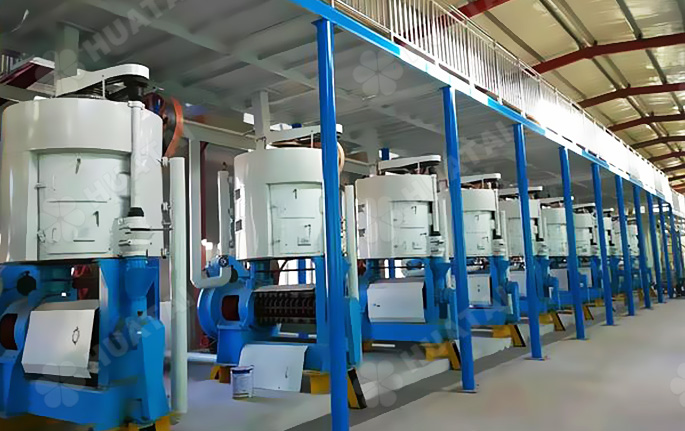
Oil pressing equipment selection should begin with the raw material and the intended processing route rather than with machine specifications alone. Mechanical pressing is commonly evaluated for its process simplicity and suitability for different scales, while vegetable oil extraction systems may be considered when the project requires an alternative or complementary oil recovery method.
| Planning factor | Why it matters | Typical equipment consideration |
|---|---|---|
| Raw material characteristics | Different oilseeds require different preparation and processing conditions. | Cleaning, crushing, flaking, cooking, pressing, or extraction equipment. |
| Planned capacity | Capacity determines line scale, material flow, and supporting utilities. | Matching equipment configuration and flexible production design. |
| Automation level | Automation influences labor requirements, process monitoring, and operating consistency. | Intelligent control, centralized monitoring, and automated process coordination. |
| Oil quality target | The finished product specification determines the treatment and refining requirements. | Filtration, crude oil treatment, and edible oil refining equipment. |
| Environmental and energy requirements | Energy use, emissions, waste handling, and operating conditions affect project sustainability. | Efficient equipment layout and process solutions designed for controlled operation. |
Qi'e Grain and Oil Machinery Co., Ltd. supplies automatic peanut oil production line equipment designed for different peanut oil processing requirements and international project environments. The system can integrate cold pressing and hot pressing technologies, allowing the process route to be planned around oil quality, product characteristics, and production objectives.
The line can also be configured with edible oil refining equipment for further treatment of crude peanut oil. Intelligent control supports coordinated operation and can help reduce manual intervention, while flexible line design allows the equipment arrangement to be considered for large agricultural enterprises, small and medium-sized oil mills, and international trading projects.
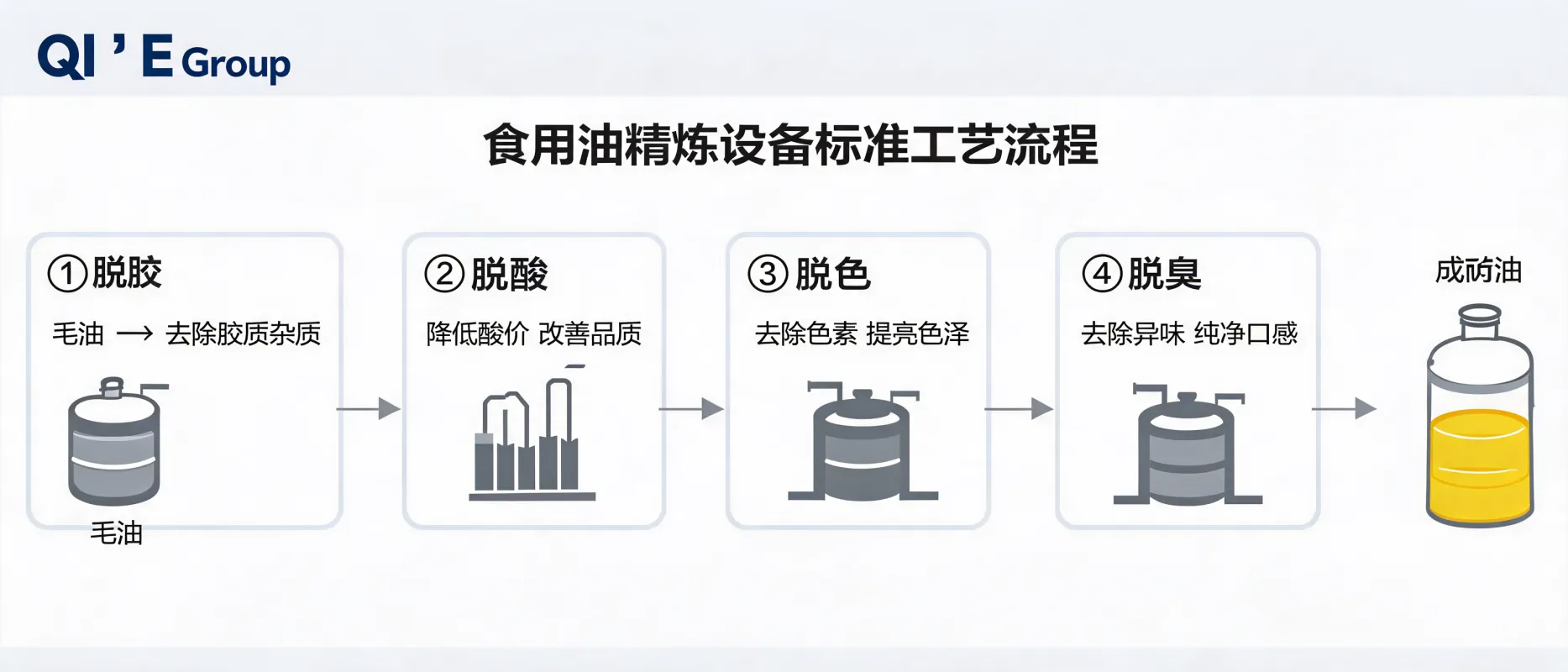
A refining line is considered when the project needs to improve the characteristics of crude oil and produce edible oil that meets defined quality requirements. The appropriate refining configuration depends on the raw material, crude oil condition, target product, local operating requirements, and applicable market standards.
For this reason, edible oil refining equipment should be planned together with the pressing or extraction section. Coordinating the two sections helps create a more consistent material flow and avoids selecting refining equipment without considering the condition and volume of the crude oil produced.
A food oil production line is a complete engineering project. In addition to individual machines, buyers should evaluate layout planning, process connection, installation conditions, operator training, spare parts, maintenance access, and long-term technical support.
The right food oil production line should match the raw material, capacity, quality objective, operating environment, and budget. Qi'e Grain and Oil Machinery Co., Ltd. combines oil pressing equipment, vegetable oil extraction systems, edible oil refining equipment, and project services to help customers plan a practical processing solution.
With experience in grain and oil machinery and products serving markets across Asia, Africa, South America, and other regions, Qi'e Grain and Oil Machinery Co., Ltd. focuses on technology innovation, product quality, and service support for long-term B2B cooperation.
 51
|
51
|
 equipment selection capacity matching raw material characteristics process flow Qi'e Grain and Oil Machinery Co., Ltd.
278
|
purchasing parameters requirement checklist site conditions refined oil indicators inquiry and comparison Qi'e Grain and Oil Machinery Co., Ltd.
493
|
small oil mill small oil press machine automatic oil press machine oil mill planning Qi'e Grain and Oil Machinery Co., Ltd.
419
|
Qi'e Grain and Oil Machinery Co., Ltd. grain and oil machinery equipment oil pressing equipment oil production line edible oil refining equipment
56
|
grain and oil machinery solutions oil production line oil pressing equipment edible oil refining equipment Qi'e Grain and Oil Machinery Co., Ltd.
equipment selection capacity matching raw material characteristics process flow Qi'e Grain and Oil Machinery Co., Ltd.
278
|
purchasing parameters requirement checklist site conditions refined oil indicators inquiry and comparison Qi'e Grain and Oil Machinery Co., Ltd.
493
|
small oil mill small oil press machine automatic oil press machine oil mill planning Qi'e Grain and Oil Machinery Co., Ltd.
419
|
Qi'e Grain and Oil Machinery Co., Ltd. grain and oil machinery equipment oil pressing equipment oil production line edible oil refining equipment
56
|
grain and oil machinery solutions oil production line oil pressing equipment edible oil refining equipment Qi'e Grain and Oil Machinery Co., Ltd.










.jpg?x-oss-process=image/resize,m_fill,h_800,w_800/format,webp)
